
The Curse of Pre-Gig Listening, Pinkpop Memories, and Joost Klein’s Internet Café
From the rituals that surround live music to the artists who create their own universes, Will’s picks reflect a listener who approaches music as something to investigate, preserve, and experience across generations.
Will (@deadwaxandlinernotes) has spent years exploring the relationship between music, place, and culture. Through his work in planning policy and his research into music heritage, he has looked at how venues, communities, and scenes become part of the stories we attach to music. But not every connection he has with music comes from research or archives. Some come from the rituals fans create for themselves. Will’s best example might be the rule he has followed since his youth: never listen to an artist on the day you are going to see them live. After a series of coincidences that seemed too specific to ignore, the superstition stuck, becoming another small piece of the stories that surround the music he loves.
That combination of curiosity, history, and personal connection shapes the way Will approaches music. He is drawn not only to what artists create, but also to the ideas, experiences, and circumstances surrounding it. A record can become a marker of a specific moment, a live performance can become a memory shared with thousands of others, and an artist’s creative choices can open the door to an entirely new way of seeing music.
Across the August 5 to 9 prompts, Will explores those connections from different angles. One asks him to reflect on an album he wishes had continued a little longer, leading to a reflection on the unexpected ways a record can become part of a personal journey. Another turns toward an artist he wishes he had discovered sooner, opening a conversation about individuality, creativity, and the discoveries that come from looking beyond the familiar. The following prompts move between the relationship between artwork and sound, the overwhelming energy of a live performance, and the artists currently pushing boundaries in unexpected directions.
Which album should have been longer?
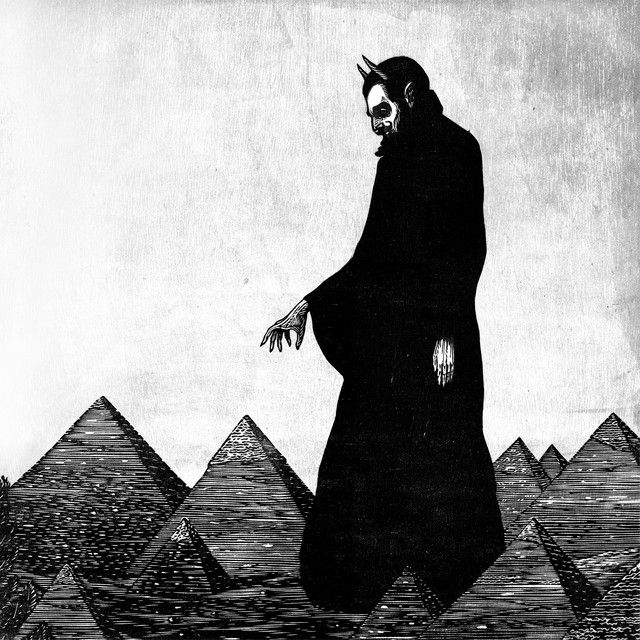
It’s a record I’ve always wished was longer. Not because the album feels incomplete, or because there’s anything missing from it. Quite the opposite. I often found myself wanting just one more song, just a few more minutes. The reason - is largely because I used to listen to it while I was walking to Andy’s Man Club (a UK mental health charity).
Those walks were often filled with anticipation and nerves. However much I knew attending was the right thing to do, there was always that moment beforehand where doubt would creep in, or you naturally look for excuses not to go. In Spades became the soundtrack to those journeys. I’d previously seen Greg Dulli perform at Mark Lanegan’s memorial show and had become quite fixated on his work with Afghan Whigs at that time. Writing this has reminded me that play in Leeds soon, and I’m hoping to attend and pick up some tickets.
Greg Dulli’s voice, the darkness and vulnerability running through the record, and the feeling that beauty and discomfort could coexist, all resonated deeply with me at the time. As the album played, it gave me something to focus on and for 36 minutes or so, I could disappear into the music. And, that’s why I often didn’t want it to end. Every time the final track approached, it meant I was getting closer to digging deep and heading over to my meeting. I guess my subconscious knew it was a step closer to chatting about things I’d have rather avoided. I would find myself wishing for another song, because I wanted to delay the destination for just a little longer.
I suppose my connection to this album is much more driven by my own sentimentality than just purely the clear musical qualities on display in this work. That said, the album itself presents a journey. What makes In Spades so rewarding is its balance between variety in the approach to writing and the cohesiveness of the album in this 36 minutes. The songs never feel like they are uniform or blur into one another, yet they seem to belong together instinctively. It starts slowly with “Birdland,” with Gregs distinctive vocal style. I’ve seen it described somewhere that - as an album, it opens almost like a curtain rising on a theatre piece. “We’ll come together when the feeling’s right - We’re coming alive in the cold.” It’s quite brooding and menacing, then transitions and ignites with the more tempo rousing “Arabian Heights.” “Demon in Profile,” again offers a lyrical shift and themes become more familiar to those who know Dulli’s past work. As the title alone suggests, a person confronting the more challenging version (demon) of themselves. And, this is the salient point about the album - as a body of work, each track feels unique and distinctive but yet complement and transition one another so effortlessly.
“Toy Automatic” has a degree of rebirth, and I love the anthemic opening chords. I wasn’t familiar with their full catalogue, but having watched Greg at the Mark Lanegan memorial, I realised how much I’d overlooked him and his work. Having explored more of their work over the last couple of years, in context, you see In Spades positions itself as the sound of a band growing older without growing safer. It transforms the Afghan Whigs’s familiar works of more rock / guitar led material, into something more atmospheric, cinematic, and reflective.
Looking back now, that’s probably one of the highest compliments I can pay a record. It became part of a chapter of my life. Andy’s Man Club is an incredibly important UK based mental health initiative. As soon as you walk through the door, all the anxiety vanishes immediately, and you are left wondering why you were so anxious about attending. But such routines become cyclical and if only the mind was a simpler thing. Today, when I hear “In Spades,” I’m reminded of those walks into town and the apprehension, the uncertainty and trepidation. But, it’s an album that gives me belief that things can and do improve - even if it’s an album that could have been a bit longer 😉!


Which artist did you wish you had discovered sooner?
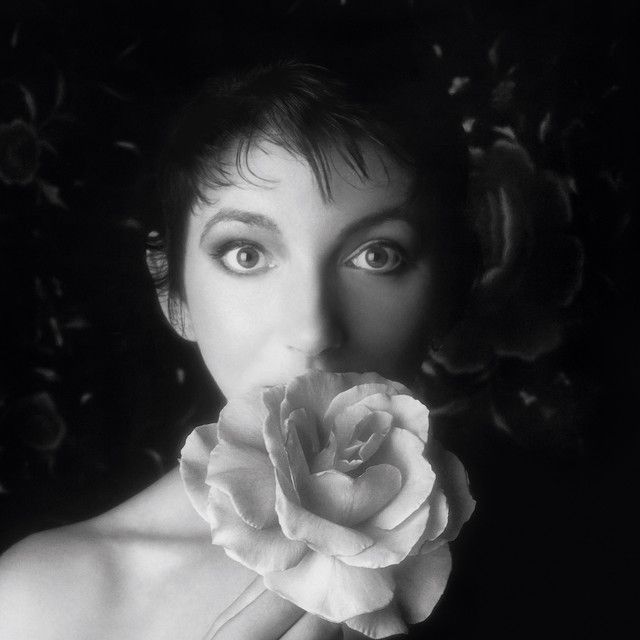
Kate Bush has always felt like an artist who exists entirely in her own world for me. Kate Bush, there is never any doubt. Her voice, her phrasing, her storytelling, and her artistic vision are utterly unique. Her songs feel deeply human while at the same time possessing an almost dreamlike quality. From a young age, I found myself captivated by her art. In reflecting now, I guess she would be one of my earliest recollections of challenging my understanding of what music could be.
Exploring her work, beyond the “hits” was a sense of mystery and creativity that invited curiosity and encouraged deeper exploration, and I think this is a value and habit I’ve carried into my love of music. She is an artist who embraces individuality without compromise.
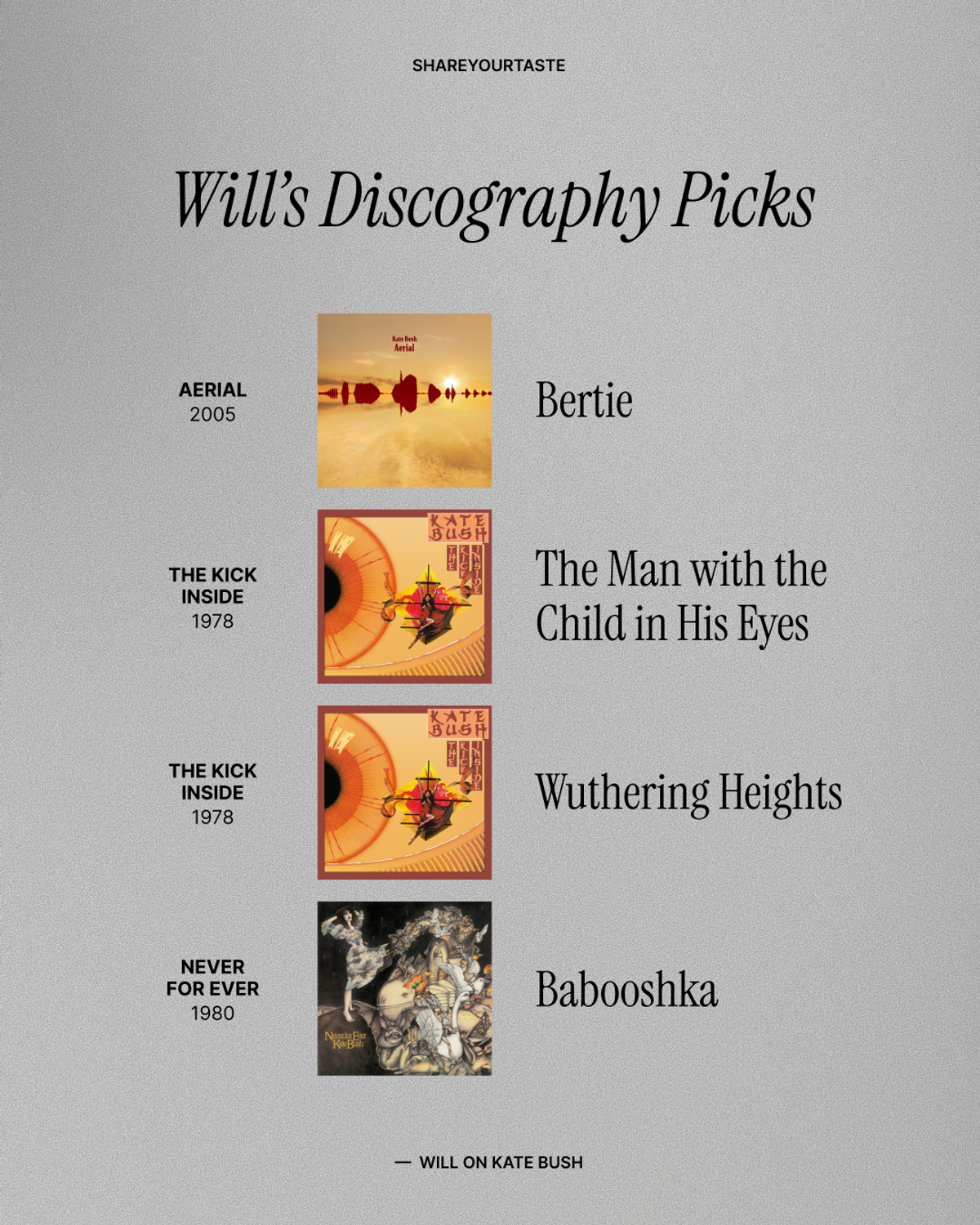
Her work is deeply emotional, intellectually rich without being inaccessible, and experimental without losing its humanity. She creates art that rewards attention and reveals new layers over time. Most recently, this has been demonstrated once again as she released the “Little Shrew (Snowflake),” which was a short, animated film which she wrote and directed in 2024. It follows a tiny shrew making its way through a bombed-out city in search of hope, using a new edit of her song “Snowflake” from 50 Words for Snow. The film was created in partnership with the charity War Child. Incredibly moving and shifts the message and meaning in her previous work.
In a world where so much music can feel shaped by trends, or the industry, Kate Bush has always struck me as remaining timeless and intrinsically authentic. Her blog and even recent interviews around the Stranger Things hype that her track “Running Up That Hill” demonstrated this. She’s always remained appreciative and considered but guided by her own vision. With the Stranger Things audience, she didn’t treat the younger audience as outsiders discovering “old music.” Instead, she seemed genuinely delighted that people who weren’t even born when the song was released were connecting with it. She spoke positively about how modern technology allows music to find new audiences (and appeared very) amused by things like “TikTok trends” inspired by her work.
I only wish I could truly have called myself a fan at a much, much younger age. Perhaps then, maybe I would have been able to attend her 2014 residency at the Hammersmith Apollo. That said, I am adamant that she will appear at Glastonbury one day! It must happen. Surely?

Which album cover perfectly illustrates the music inside?
The artwork for LOW’s Hey What has always fascinated me. At first glance, it appears abstract but striking. I’ve seen it described elsewhere as having no obvious focal point, and feels fractured, and strangely beautiful. In many ways, it mirrors the music itself. Hey What consists of distortion, the driven electronics (Alan on his Danelectro guitar), and the layers of noise, the soundscapes and craft of their songs - others have noted that this delivers a remarkable tenderness and grace.
Hey What was on heavy rotation during one of the most difficult periods of my life, as I was both losing and lost my mother to cancer. Looking back, loss and grief especially - it’s one of those chapters of life where it is impossible to separate music from those emotions (for me, anyway). The uncertainty, the grief, the change and the attempts to find moments of peace amid the chaos – I seemed to see all this reflected in the album’s sound and even in its artwork. Like the cover itself, life during that period often felt blurred and difficult to navigate or make sense of. I remember vividly driving home from a visit to the hospital, at night, and “Days Like These” came on and I had to have a moment where I couldn’t focus on driving and had to pull over and just sit and listen. It struck me so profoundly, but in a weird way it felt like what I needed to hear in that moment.
What makes the album even more poignant now, is that its story now overlaps with another loss. I think it was roughly a year after the albums release, that Mimi Parker sadly passed away. It was from ovarian cancer (the same cancer that took my mother). Knowing what was to come, in some way now lends the record an even more emotional weight.
One of the most meaningful moments connected to this period, came just a couple of years ago when Kevin Cole, (@djkevincole) the legendary Pacific Northwest broadcaster) and one of the great champions of independent music, shared my story on KEXP. This was during his show for “Music Heals: Beyond Cancer.” This is a special day of programming devoted to exploring how music can provide comfort, connection, and resilience for people affected by cancer. After reading my story he then played “Days Like These”. The artwork may appear rather abstract, but it serves as a reminder of my mother, of Mimi, and of the healing capacity of music. Kevin and his team at KEXP also beautifully capture in this day of programming how music brings us all together under an umbrella, and we aren’t alone. And music truly does heal. I’m always grateful for that and still reflect on this often.

Which song comes to mind when you hear the word "loud"?
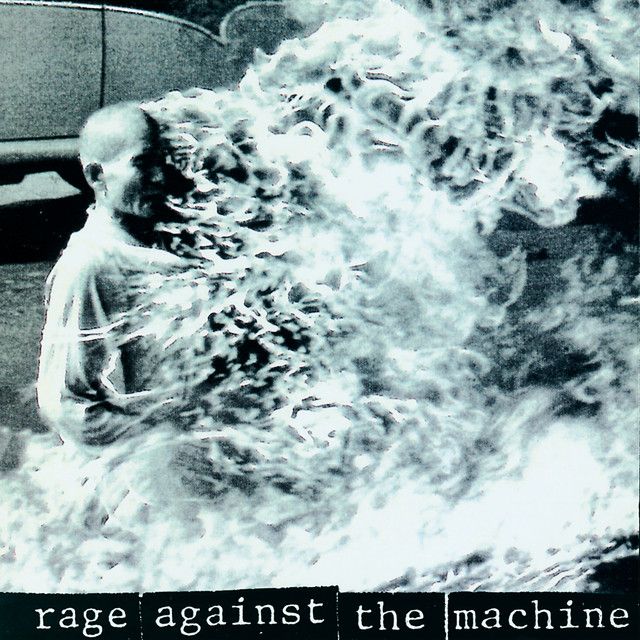
Whenever I listen to this track, it just takes me back to what is probably the loudest show I ever witnessed. It is funny how some gigs end up becoming markers in your life. Back in 2008, we headed out to our first Pinkpop Festival for the return of Rage Against the Machine. I wasn’t especially knowledgeable about them at the time, but one of my friends was obsessed. The moment the news had broken that Rage had reformed and were playing Coachella, it was huge. Then, they announced a European date. My friend informed me “wherever they’re playing, we’re going.” Before I knew it, he rang me and informed me a ferry was booked. “We can get to the Netherlands, and once off the Ferry, we would just simply work it out from there.”
Fast forward to this headline set, and I can still remember vividly them walking out in front the sea of people onto the stage, clothed in those now-iconic orange jumpsuits. They stood motionless with the Guantanamo Bay style prisoner covers over their heads and a siren rang out across the site. After what felt like minutes stood in anticipation they launched into the intro of “Bombtrack.” The second it kicked in; I didn’t need to jump myself! The mass of bodies in unison bouncing up and down just carried me… up and down, up and down. The force of the audience lifted me like a wave, and the volume of both the band, the crowd shouting along was immense.
At one point, I looked up towards the hill which provides the distant backdrop behind the Pinkpop main stage, and I could see a gathering of people upon the hill These were people unable to get tickets but desperately trying to catch a glimpse of what was happening below and listen in. I did later see them at Leeds Festival on this same tour, but it didn’t have the same intensity and the theatrical aspects (prisoner attire) of the show had been stripped down and the sound was less intense (much more managed – I guess due to local limitations under the event licensing). Although they did switch “Born a Broken Man” and “Wake Up” (played at Pinkpop) for “Renegades of Funk” and “War Within a Breath” (played at Leeds). If memory serves me correctly, “Renegades” was very rarely played on that run of dates.
This year, almost two decades later, I find myself back at Pinkpop once again. Tom Morello (Rage Against the Machine guitarist) made a visit on his solo tour. He was joined on stage by his young son, and during the set Tom reflected on his previous historic appearances at the festival. This included his legendary 2008 Rage Against the Machine headline show. He also mentioned when they played the festival previously and the show (and crowd) registered earth tremors, which were recorded at a close by seismology centre.
There was another nice symmetry to it all. Back in 2008 Dave Grohl and the Foo Fighters had played the festival. This year, they closed the event. So nearly twenty years on, I was back at Pinkpop with my closest friends, watching Tom Morello and then the Foo Fighters again. A lot has changed since back then. We’re older now and many more responsibilities in life. We have a fair few Pinkpop’s, Leeds Fest’s, Download’s, Slamdunk’s etc under our belts. That said, arriving at the Pinkpop grounds will always feel a special moment. Older, certainly. Wiser? The jury is still out. Roll on next year.

Which artist is doing interesting work right now?
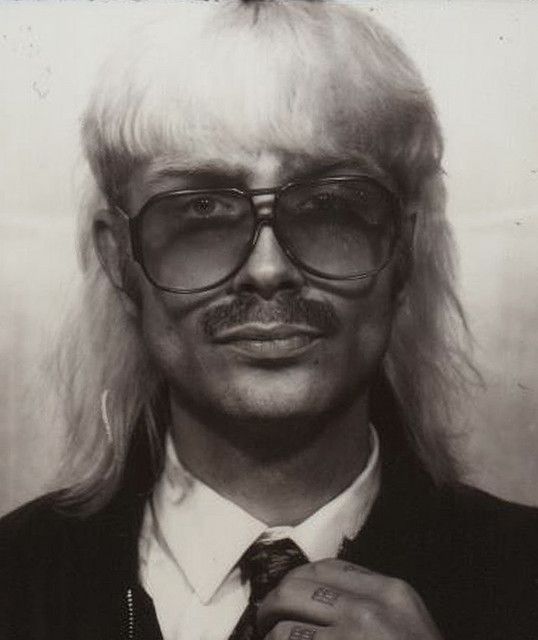
In recent years, I have found myself increasingly drawn to artists such as Joost Klein, Ski Aggu, Tommy Cash, Käärijä, and Oliver Tree. Could we call it Avant-Pop? I suppose much of what I’m articulating here refers to the movement they encapsulate more than Joost in particular. What connects them, for me is not simply their music or the great collaborations - but the way they embrace absurdity, humour, individuality, and unpredictability. Their work feels refreshingly peculiar and unconcerned with convention. Joost and similar acts often frequent the Eurovision competitions and production. One of the things I love about these acts is how they challenge pop expectations, embrace satire and create something that is uniquely their own.
What excites me, is how these artists blur the lines between music, performance, character, and the art. Obviously, this isn’t exclusive to this scene, but their work often feels very unconventional, self-aware, ironic, playful, and sometimes intentionally contradictory and self-deprecating. They take familiar ideas or genre conventions and twist them into something unexpected, creating performances, and content that can be at once absurd, thought-provoking, sincere, moving, and satirical.
Watching a Joost Klein show is quite the rollercoaster. One minute you are losing your mind in what feels like a rave, the next you are shedding a tear as he processes and articulates grief (the loss of his parents at a young age), acceptance and navigating change. Then, you are laughing at a video or some fantastically bizarre aspect of his production.
They push boundaries and embrace eccentricity. Whether through visual aesthetics, the stage performance, humour, storytelling, or unconventional artistic choices, they create worlds that feel distinct and authentic to their own vision. My favourite recent escapade was Joost’s creation of an internet café! As his Internetcafe 24/7, Joost created an online presence of a functioning (old school/dated) internet café. Via social media, merch and other content he managed to bring the fan in and make them feel part of the experience. The café would feature as part of a single from Unity in “Why Not???,” mixing humour, loneliness, gaming references, YouTube culture, his experience of Eurovision, algorithms, Wi‑Fi, and online identity to poke fun at the chronically online world.
As noted with the late Oliver Tree, their willingness to be peculiar, experimental, and unapologetically true to their vision – has produced (in my view) some of the most interesting music around. For me, this kind of art serves as a reminder that creativity does not always need to be serious to be meaningful. What might initially seem chaotic or humorous frequently contains commentary on culture, identity, fame, modern life, or the nature of performance itself. Sometimes the most profound ideas are communicated through humour, exaggeration, or apparent nonsense.
Beneath the apparent absurdity, these artists create spaces where joy, curiosity, experimentation, and self-expression are celebrated. Their work encourages audiences to question assumptions, embrace individuality, and find value in the unconventional.

Reading Will’s answers, one thing becomes clear pretty quickly: he rarely stops at the song itself. There is always another layer waiting somewhere. The venue where something happened, the people who shaped a scene, the story behind a record, or the reason a particular album ended up meaning so much at a particular point in life.
That way of looking at music probably has something to do with the fact that Will works in planning policy and has spent much of his career exploring cultural heritage, including the places and communities connected to music history. His research has taken him from grassroots venues in the UK to the punk and grunge sites of the Pacific Northwest, speaking with the people who helped shape those scenes. But outside of the archives and research, there is also the person who still gets excited about a festival crowd, a new discovery, or putting on a record and understanding how it fits into a bigger story.
Maybe that is why even his smallest music rituals become stories of their own. The superstition around not listening to an artist on the day of a concert started after a series of unfortunate coincidences: a cancelled train after listening to Alkaline Trio before a show, a friend’s breakup before another gig, a pickpocketing incident at a different concert, and a friend being removed from a venue after drinking too much. Eventually, the only explanation left was the “curse” itself. Years later, the ritual remains, less because of the bad luck and more because it has become part of the shared mythology surrounding live music.
For Will, music seems to exist somewhere between the things we inherit, the things we discover, and the things we carry with us. A song can become part of a difficult walk. A concert can become a marker in time. An artist can open the door to an entire world worth exploring.
An archaeologist and lifelong music fan who loves digging deeper, whether that means exploring forgotten scenes, revisiting classic albums, or discovering the stories behind the songs.


